
![ApptioCareers-Employee[1]](data:image/svg+xml;base64,PHN2ZyB4bWxucz0iaHR0cDovL3d3dy53My5vcmcvMjAwMC9zdmciIHZpZXdCb3g9IjAgMCAyMjUgMjc1IiB3aWR0aD0iMjI1IiBoZWlnaHQ9IjI3NSIgZGF0YS11PSJodHRwcyUzQSUyRiUyRnd3dy5hcHB0aW8uY29tJTJGd3AtY29udGVudCUyRnVwbG9hZHMlMkZlbGVtZW50b3IlMkZ0aHVtYnMlMkZBcHB0aW9DYXJlZXJzLUVtcGxveWVlMS1xZzVuenB5MHdoaWJtbzZvdmJqNGM3MHh0aTUzdmo1OHM0endwajh0dHMucG5nIiBkYXRhLXc9IjIyNSIgZGF0YS1oPSIyNzUiIGRhdGEtYmlwPSIiPjwvc3ZnPg== "ApptioCareers-Employee[1]")
In today’s hybrid technology environments, forecasting technology spend has become increasingly difficult. Rapid cloud adoption, expanding IT portfolios, shifting business priorities, and ongoing cost pressures make it challenging for IT and finance leaders to confidently answer a fundamental question: What will we spend next, and why?
At the same time, technology budgets continue to rise. In our survey of technology leaders, we found that 74% of organizations are increasing IT budgets—a quarter reporting significant jumps. Traditional approaches rely heavily on static models, manual assumptions, and historical averages that struggle to account for volatility and change. As a result, teams spend countless hours manipulating data and reconciling numbers, often ending up with forecasts that are difficult to explain and even harder to trust.
Organizations need a better way forward, one that replaces manual effort and intuition with intelligent, data-driven forecasting that scales across on-premises and cloud environments.
Introducing Intelligent Forecasting
That’s where IBM Apptio Planning and IBM Cloudability’s new Intelligent Forecasting capabilities come in.
Together, these capabilities introduce an AI-powered approach to forecasting technology spend across on-premises and cloud, replacing manual, spreadsheet-driven processes with automated, data-driven forecasts. Both are powered by the same Intelligent Forecasting engine, which uses IBM watsonx advanced forecasting models and machine learning to learn from historical spend patterns and generate forward-looking projections that adapt as technology environments evolve.
How Intelligent Forecasting Uses Multi-Model Analysis
Technology spend does not follow a single pattern. Some costs grow steadily, others fluctuate seasonally, and others change abruptly due to business or architectural shifts. Intelligent Forecasting addresses this using a multi-model approach. Instead of relying on a one-size-fits-all model, the forecasting engine evaluates multiple statistical and machine-learning models in parallel, each optimized for a particular input data series shape, and automatically selects the model that best fits the historical behavior of each cost stream.
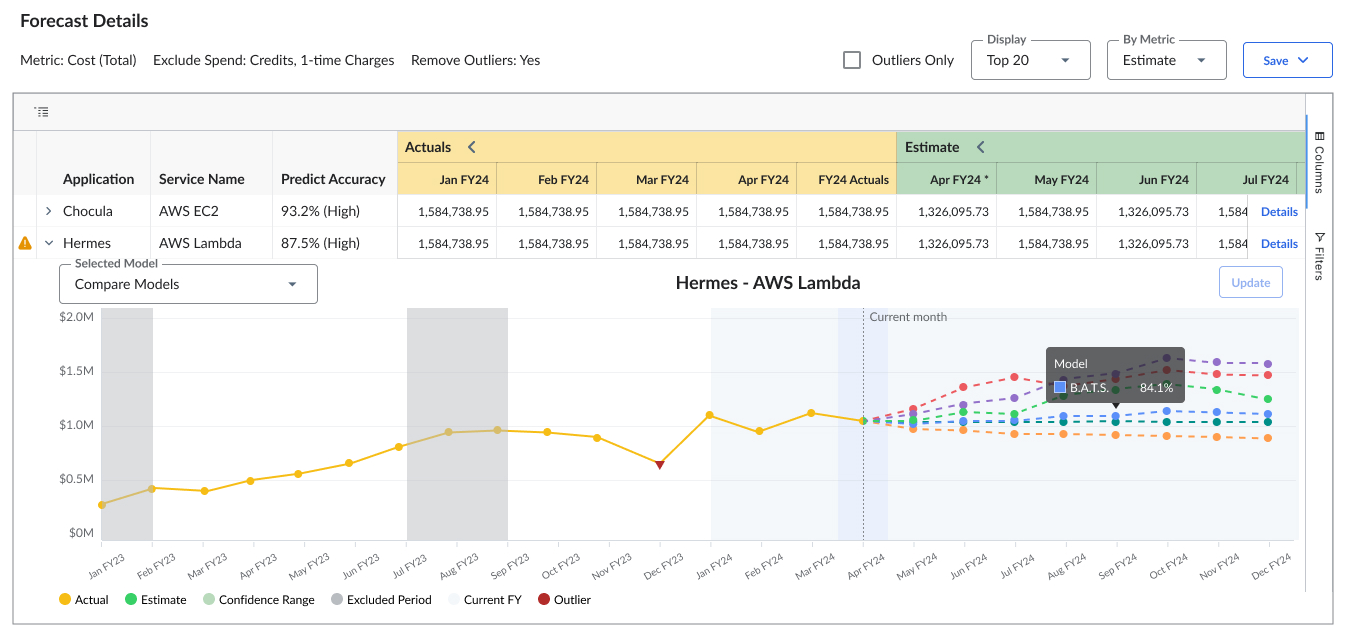
To increase trust and usability, Intelligent Forecasting provides transparency and control over model selection. Users can view the results of all evaluated models, compare alternative projections, and understand why a particular model was selected by default. When business context suggests a different outlook—such as known investments, planned migrations, or strategic changes not yet reflected in historical data—users can override the auto-selected model with a different choice.
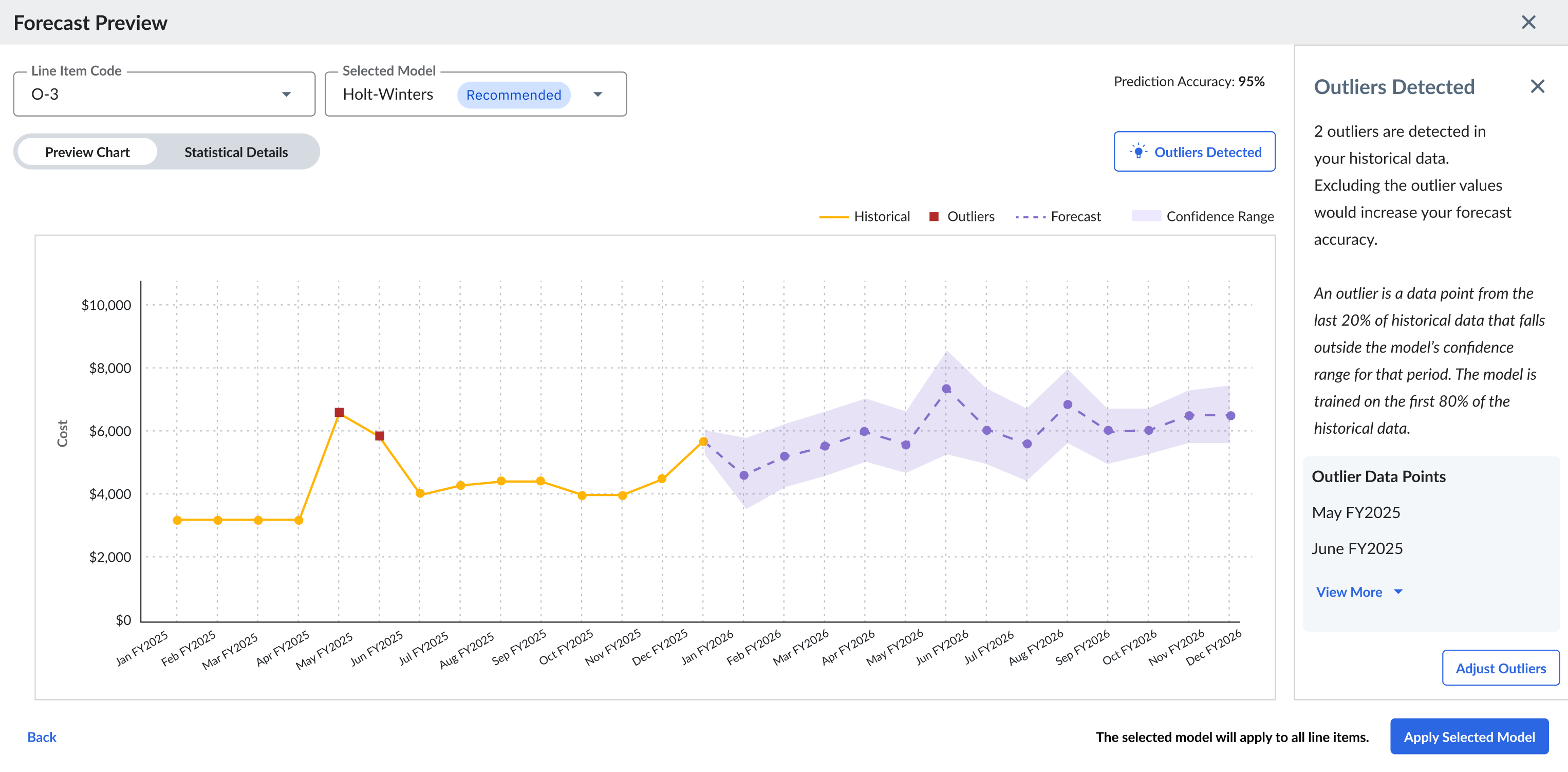
By reducing reliance on manual assumptions and static averages, Intelligent Forecasting helps teams spend less time building and maintaining forecasts, and more time making informed decisions. Built-in anomaly detection identifies and adjusts for irregular spikes or one-time events, ensuring forecasts remain accurate, reliable, and reflective of true spending patterns.
While both products share this common intelligent forecasting foundation, they apply it in complementary ways.
- Apptio Planning uses Intelligent Forecasting to support planning and forecasting across all IT spend.
- Cloudability applies Intelligent Forecasting specifically to cloud spend, addressing the unique dynamics of variable and consumption-based cloud costs.
Together, they provide a more complete forecasting story, aligning IT finance and cloud teams around a shared, confident view of future technology spend.
Intelligent Forecasting in IBM Apptio Planning
Accurate forecasting is critical to effective IT planning but too often, it relies on manual spreadsheets, static assumptions, and time-consuming updates. Intelligent Forecasting in Apptio Planning changes that.
Now available in Apptio Planning, Intelligent Forecasting automatically generates forecasts across IT spend using historical data and spending trends. The forecasting capability also identifies outliers and unusual spending patterns, helping teams surface anomalies early and improve forecast quality. To further increase transparency and trust, teams can choose between different forecasting models and compare them using accuracy scores, selecting the model that best fits their data and planning needs.
Instead of building and maintaining complex models, IT finance teams can rely on automated, data-driven forecasts that adapt as spending patterns evolve. Forecasts are generated without manual input, while outlier detection highlights data points that may require review. Model comparisons enable teams to validate forecast performance and confidently apply the most accurate approach—allowing them to focus on decision-making rather than data preparation.
Key benefits include:
- Reduced manual effort: Replace spreadsheet-driven processes and subjective assumptions with automated, system-generated forecasts.
- Improved accuracy and insight: Forecasts dynamically adjust based on historical trends, while outlier detection flags unusual variances that could impact forecast reliability.
- Greater transparency and confidence: Transparent model selection, explainable forecasts, and visibility into anomalies provide a stronger foundation for IT budgeting, forecasting, and strategic planning.
Intelligent Forecasting in IBM Cloudability
Cloudability modernizes cloud forecasting with a collaborative, FinOps-driven planning experience. Cloudability enables organizations to build flexible, driver-based forecasts while promoting accountability through clear ownership of cloud spend and ongoing spend-to-plan tracking.
The new multi-model Intelligent Forecasting engine brings greater control and improved accuracy to cloud forecasts. Teams can evaluate and select from multiple forecasting models, choosing the approach that best aligns with their cloud usage patterns and planning requirements. The new reporting makes it easier to visualize forecast performance, compare model accuracy, and monitor spend against plan.
With additional controls, improved accuracy, and more intuitive reporting, Intelligent Forecasting in Cloudability increases confidence across cloud, FinOps, and finance teams, leading to greater efficiency and reduced variance to plan across cloud spend.
Key benefits include:
- Flexible, model-driven forecasts: Generate cloud forecasts using multiple models and select the approach that best reflects your usage patterns, pricing dynamics, and optimization strategies.
- Clear, actionable visualizations: Easily interpret forecasts with enhanced, intuitive visualizations that highlight trends, variances, and spend-to-plan performance across cloud environments.
- Greater transparency and confidence: Gain visibility into forecast data, model performance, and accuracy metrics, helping FinOps teams understand, validate, and trust forecast results.
Integrating IT Planning and Cloud Financial Planning
While Intelligent Forecasting is available independently in both Apptio Planning and Cloudability, organizations can unlock greater value by integrating the two.
When integrated, Cloud Financial Planning functions as the cloud sub-ledger to Apptio Planning. Apptio Planning serves as the system of record for IT budgets, forecasts, and plans while Cloud Financial Planning manages the detailed, consumption-level cloud financial data that underpins those plans.
Through schema mapping and data synchronization, granular cloud costs captured in Cloud Financial Planning are aligned to IT Planning structures such as cost centers and accounts. This ensures cloud forecasts are based on real usage and pricing dynamics, while remaining fully integrated into broader IT financial plans.
By connecting FinOps and IT Finance through a shared planning framework, organizations establish a single source of truth where cloud cost detail is maintained and rolled seamlessly into enterprise IT plans. The result is improved collaboration, more accurate forecasts, and better-informed budgeting decisions across both cloud and IT teams. To learn more about Intelligent Forecasting or the integration between Apptio Planning and Cloudability, schedule a demo.


