![ApptioCareers-Employee[1]](data:image/svg+xml;base64,PHN2ZyB4bWxucz0iaHR0cDovL3d3dy53My5vcmcvMjAwMC9zdmciIHZpZXdCb3g9IjAgMCAyMjUgMjc1IiB3aWR0aD0iMjI1IiBoZWlnaHQ9IjI3NSIgZGF0YS11PSJodHRwcyUzQSUyRiUyRnd3dy5hcHB0aW8uY29tJTJGd3AtY29udGVudCUyRnVwbG9hZHMlMkZlbGVtZW50b3IlMkZ0aHVtYnMlMkZBcHB0aW9DYXJlZXJzLUVtcGxveWVlMS1xZzVuenB5MHdoaWJtbzZvdmJqNGM3MHh0aTUzdmo1OHM0endwajh0dHMucG5nIiBkYXRhLXc9IjIyNSIgZGF0YS1oPSIyNzUiIGRhdGEtYmlwPSIiPjwvc3ZnPg== "ApptioCareers-Employee[1]")
FinOps teams are increasingly overwhelmed by where to begin when managing AI costs. Unlike traditional cloud workloads, AI introduces volatile token consumption, shared models, rapid experimentation, and limited cost attribution.
This data looks markedly different from the metrics FinOps practitioners are familiar with, but in reality, it’s another set of cost and utilization metrics that can be used to measure value. What makes AI different is how quickly usage scales before governance, ownership, or unit economics can be established, leaving FinOps teams with fragmented data and little clarity about which workloads create business value.
The challenges of rapidly growing AI consumption don’t invalidate FinOps principles. They make FinOps more urgent.
Without a practical starting point, though, teams struggle to prioritize controls, assign accountability, and manage AI costs without slowing innovation. Here’s where to begin.
Where to Start: Understanding Your AI Footprint
The starting point for any FinOps team is understanding what AI tools are in use, how much they’re being used, and what portion of the cloud footprint supports AI workloads and the resources associated with them.
Start by building a baseline of your AI footprint:
- Review cloud billing exports and AI-provider data to understand where AI costs originate.
- Map shared or untagged costs to accountable owners.
- Separate training from inference workloads and experimentation from production environments.
- Identify optimization opportunities, including idle endpoints, oversized models, duplicate tools, and unexpectedly high-cost requests.
- Meet with engineering and business teams to understand how AI is being used across the organization.
- Assess whether MCP servers are in use and identify the tools, systems, and data sources that AI agents frequently reference.
A lightweight baseline reveals where AI is used, who owns it, what value it delivers, and where optimization and governance should begin.
Add AI Guardrails Early
AI prototypes spread quickly across departments, creating duplicate tools, unmanaged model usage, and unclear cost ownership. Traditional dashboards can miss rapid changes in token consumption or GPU demand.
Introduce cost governance before models reach production by establishing a cross-functional review process that:
- Bring together engineering, security, finance, and relevant product owners.
- Defines attribution rules and establishes clear ownership for AI costs.
- Sets usage limits and governance guardrails before workloads scale.
- Evaluates model choices based on cost, usage, and business requirements.
- Identifies overlapping implementations and duplicate tools before they reach production.
Early collaboration helps organizations avoid duplicated effort, improve accountability, and establish governance before AI costs become difficult to control.
Govern AI Access and Usage
As with other cloud operations and SaaS applications, control access where you can. Use an approved service catalog, require SSO, and assign role-based permissions according to business need, data sensitivity, and spending authority.
Where possible, provision licenses centrally, set expiration dates for temporary access, and automate removal when users change roles or stop using a tool. Monitor active users, license utilization, agent executions, token consumption, model selection, and cost by team or use case. Implement scheduled processes to reclaim inactive licenses, identify duplicate tools, detect abnormal usage, and enforce budgets or rate limits.
Regular reviews involving FinOps, security, procurement, and engineering ensure access remains justified and every license or model workload is tied to an accountable owner and a measurable business outcome.
The goal is not to slow experimentation. It’s to give experimentation boundaries so successful prototypes can scale without creating financial or operational debt. Streamlining these governance practices and keeping them simple for users is essential.
Apply the Mindset Beyond Cloud
Whether you’re managing AI models, token consumption, cloud infrastructure, or AI-enabled software, ask one consistent question: Is this resource producing enough business value to justify its cost?
That question is the heart of FinOps, and it travels well. The same discipline that brought accountability to cloud extends naturally to AI and everything around it.
Recommended Actions
- Establish a baseline for cloud, AI, infrastructure, and software costs
- Add a cost-governance review before AI workloads reach production
- Apply FinOps principles to token consumption, costs, and model outputs
- Optimize token and model usage, and track AI unit economics to connect AI costs to AI value
How Cloudability Can Help
IBM Cloudability helps organizations move quickly from understanding their AI footprint to allocating and optimizing cloud and AI costs across the organization.
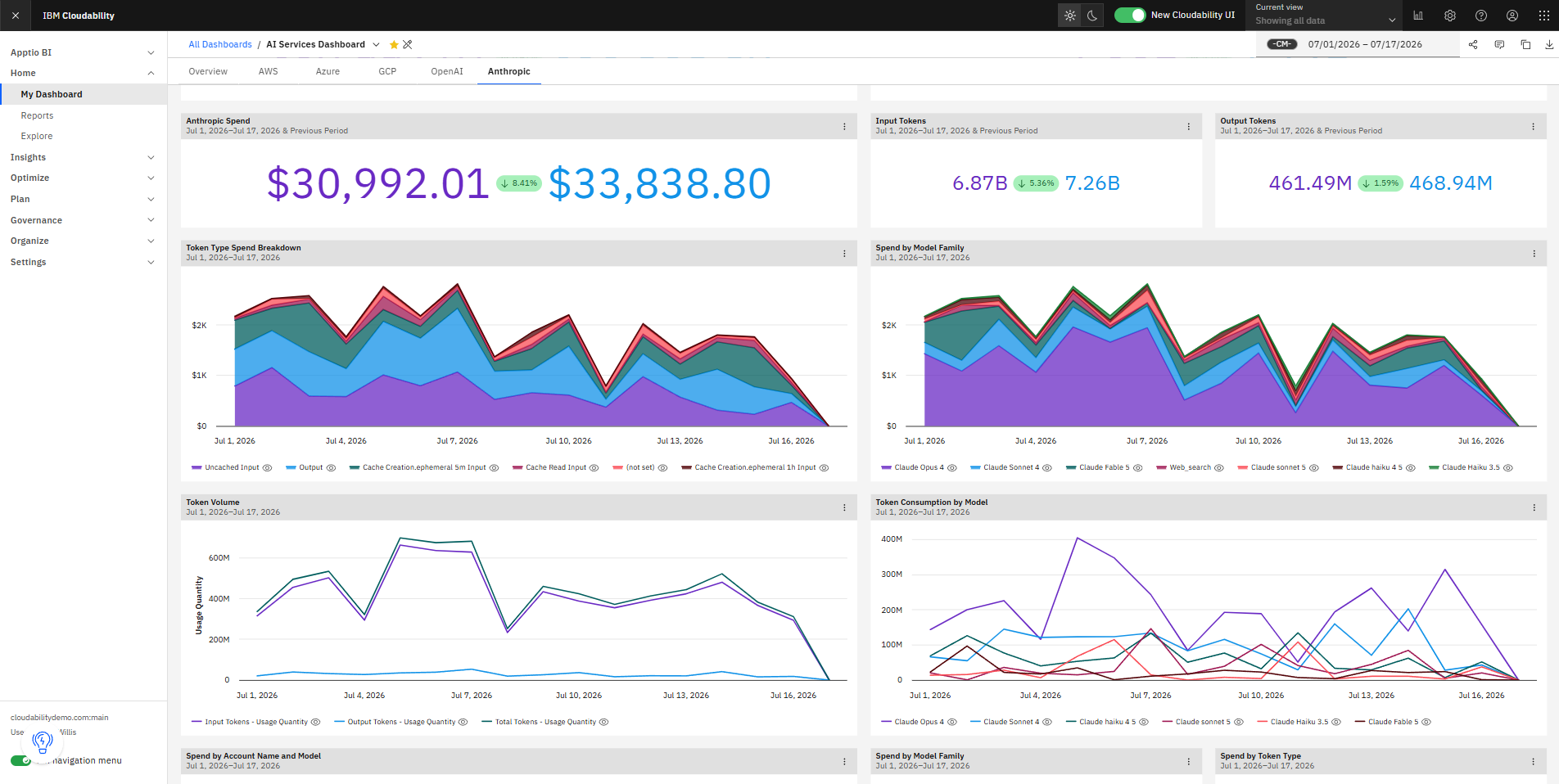
Cloudability helps FinOps practitioners understand AI economics by reporting on model utilization, token consumption, and associated costs across teams and workloads. It allocates shared AI expenses to the appropriate business units, products, or applications, giving organizations clearer ownership and accountability.
By connecting consumption and cost data to measurable outputs, Cloudability helps organizations progress from basic AI cost visibility toward actionable AI unit economics, turning AI costs into AI value.