
![ApptioCareers-Employee[1]](data:image/svg+xml;base64,PHN2ZyB4bWxucz0iaHR0cDovL3d3dy53My5vcmcvMjAwMC9zdmciIHZpZXdCb3g9IjAgMCAyMjUgMjc1IiB3aWR0aD0iMjI1IiBoZWlnaHQ9IjI3NSIgZGF0YS11PSJodHRwcyUzQSUyRiUyRnd3dy5hcHB0aW8uY29tJTJGd3AtY29udGVudCUyRnVwbG9hZHMlMkZlbGVtZW50b3IlMkZ0aHVtYnMlMkZBcHB0aW9DYXJlZXJzLUVtcGxveWVlMS1xZzVuenB5MHdoaWJtbzZvdmJqNGM3MHh0aTUzdmo1OHM0endwajh0dHMucG5nIiBkYXRhLXc9IjIyNSIgZGF0YS1oPSIyNzUiIGRhdGEtYmlwPSIiPjwvc3ZnPg== "ApptioCareers-Employee[1]")
IT financial management (ITFM) maturity is a CIO imperative. As hybrid IT, SaaS, and AI increase complexity and cost, organizations without ITFM capabilities can misalign investments and miss opportunities — and are ultimately unable to understand the value their IT investments are generating. Drawing on 18+ years of experience helping IT leaders manage $650+ billion in IT spend, Apptio created the ITFM Maturity Model. IT, finance, and business leaders can use this five-stage road map to assess their current status and take actionable steps toward more effectively optimizing IT spend and maximizing business value.
The ITFM Maturity Model
The ITFM Maturity Model is designed to turn the perceived complexity of the ITFM journey into a clear, streamlined path forward. Each of the five stages has distinct capabilities, KPIs, and outcomes. The model helps organizations understand where they are and what steps will deliver the greatest impact next, whether that’s improving cost visibility, strengthening business partnerships, getting a better sense of the value their IT spend is delivering, or scaling ITFM practices to drive innovation.
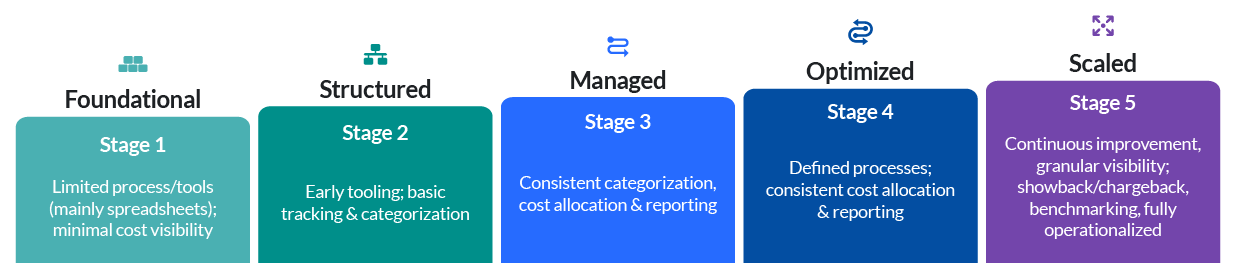
Stage 1: Foundational
Organizations at this level typically use manual processes and spreadsheets developed by finance, IT finance, or project leaders to track, manage, and forecast IT spend. This approach:
- Enables initial visibility into IT spend, surfacing gaps in data and sparking early conversations
- Identifies what IT cost data is either incomplete or the org doesn’t have (e.g., vendors, IT workforce, applications, and subscriptions)
- Reveals blind spots related to IT budgeting that can inform future investment decisions and priorities
Capturing spend data is an essential first step, but varied data formats, quality and approaches make it difficult to see the full picture. Without a unified view, organizations face blind spots that can lead to overspending and misaligned investments.
Stage 2: Structured
Moving beyond foundational capabilities, Stage 2 begins when organizations start to adopt dedicated ITFM tools that bring in needed automation and enable better cost tracking and overall visibility. Stakeholders now receive understandable data about IT usage and cost in consistent formats on a regular schedule. This improvement often results in better engagement and dialogue between IT and business leaders.
New capabilities can include:
- Some automation of financial data aggregation and reviews (ETL processes)
- A shift from ad hoc to continuous rollout of financial practices
The benefits also evolve. Most teams see:
- A reduction in manual effort and errors, freeing up time for analysis and improving data reliability
- Repeatable, scalable processes that support consistent planning and review
- Higher use and trust in IT cost data, which can strengthen business partnerships
Stage 3: Managed
Once IT spend data is more structured and data quality increases, teams can manage costs more effectively and optimize key areas of the IT environment, such as applications and services. In Stage 3, IT finance leaders share a reliable cadence of information and may also pilot cost showback processes. The ITFM team is considered a strategic partner in the matching of investments to organizational objectives, rather than just a cost center or data provider.
ITFM capabilities have advanced to:
- Leveraging richer, more consumptive data feeds
- Conducting proactive, IT-led financial analysis
- Optimizing IT investments using TCO analysis and unit economics
The outcomes expected from this level of ITFM maturity are also significant:
- More-granular analysis and defensible, data-backed decisions
- Improved trust and strategic partnering with business leaders about critical investment decisions
- Clear alignment of IT spend with business value
Stage 4: Optimized
Once IT leaders are seen as managing IT spend effectively, teams are in the position to optimize IT spend. Accordingly, Stage 4 is an inflection point for many organizations. Teams are leveraging comprehensive cost models that capture the full IT estate to understand TCO and unit economics and make informed decisions. At this stage, ITFM practices become more standardized and scalable, embedded across the business to support strategic planning.
Core, embedded capabilities include:
- Integration of ITFM tooling with core financial systems (such as ERP) to create a trusted single source of truth for IT spend
- Multi-year, dynamic forecasts driven by IT value and services
- Advanced rationalization of applications and services, leveraging advanced TCO and unit economics modeling
Consequently, these sophisticated ITFM capabilities yield more benefits. Among them:
- Unified planning and reporting, and trusted partnerships with business functions
- Improved long-term planning, as well as agility to meet changing business needs
- Strategic discussions around IT consolidation, modernization, and investment
Stage 5: Scaled
The ITFM practice engages in continuous improvement of capabilities and processes while expanding its role as a trusted partner in the strategic investment decision-making process. The higher level of automation of cost management and communication allows team members to focus on analysis and business decision-making. With ITFM capabilities fully embedded across the organization, ITFM team members function as enablers of innovation, growth, and competitive advantage, as well as operating effectiveness.
How to Use the Model
Reaching ITFM maturity will look different in every organization, depending on the organization’s capabilities, strategy, and available investment resources. The important thing is to get started. Here are three steps to consider:
- Identify gaps in KPIs. These could relate to cost allocation coverage, budget cycle time, automation of data feeds, or forecast accuracy.
- Determine the stage your organization is in and where it wants to be.
- Prioritize next steps based upon value and strategy.
Our model draws on Apptio’s 18+ years’ experience along with 1,800+ deployments across industries and geographies. It helps teams at every stage identify gaps, prioritize improvements, and strengthen ITFM practices, enabling IT leaders to demonstrate and maximize the business value of IT investments.
Moving up the ITFM maturity curve is rarely a linear process and involves a host of decisions and trade-offs. But we’ve helped hundreds of organizations across sectors make that journey successfully.
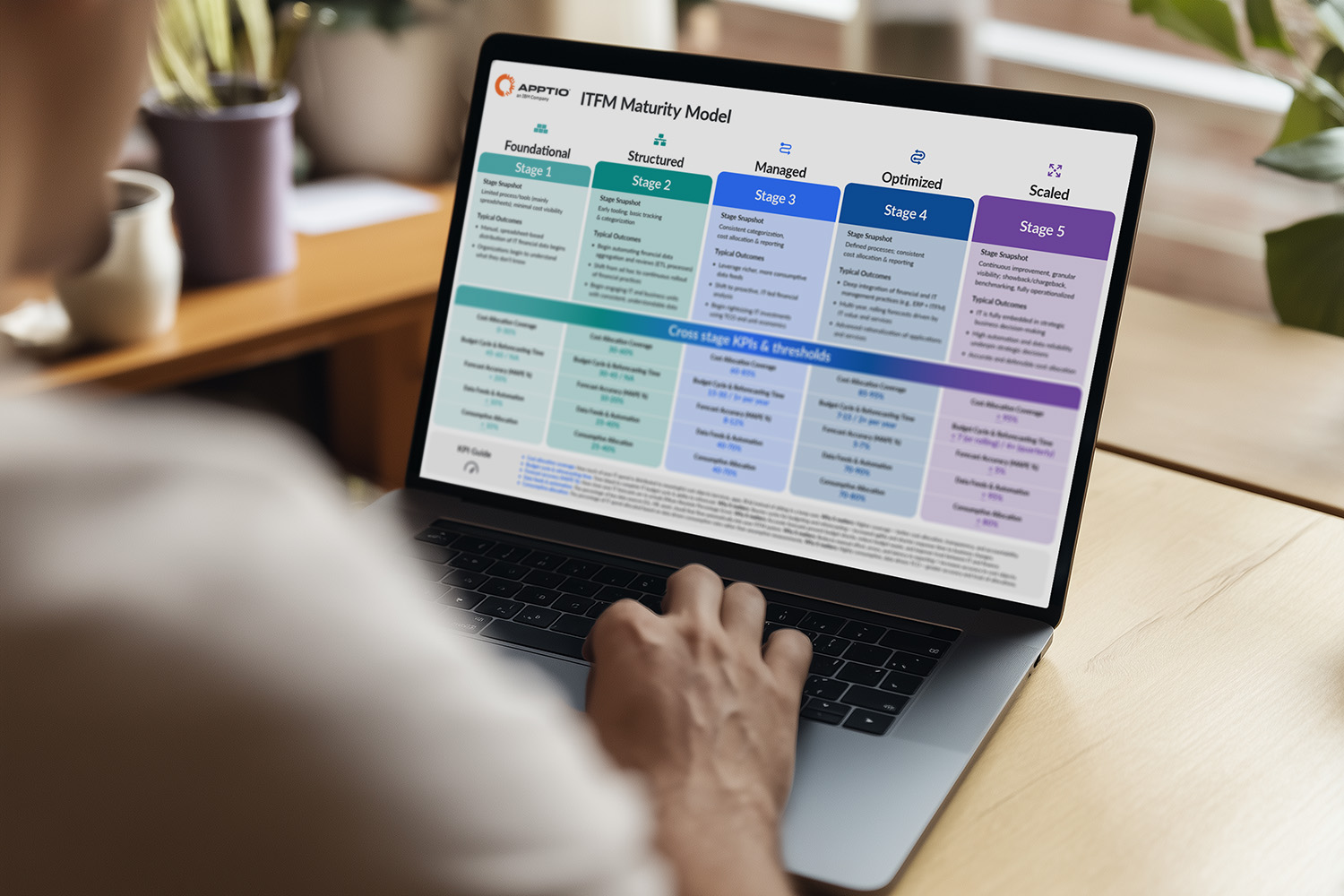
Ready to get started? Download the ITFM Maturity Model Poster to keep the stages front and center and read theITFM Maturity Model Handboo for more information.
We’re happy to receive feedback on the model, answer any questions, and explore how we can support your team. Contact us to discuss how we can work together.


