
![ApptioCareers-Employee[1]](data:image/svg+xml;base64,PHN2ZyB4bWxucz0iaHR0cDovL3d3dy53My5vcmcvMjAwMC9zdmciIHZpZXdCb3g9IjAgMCAyMjUgMjc1IiB3aWR0aD0iMjI1IiBoZWlnaHQ9IjI3NSIgZGF0YS11PSJodHRwcyUzQSUyRiUyRnd3dy5hcHB0aW8uY29tJTJGd3AtY29udGVudCUyRnVwbG9hZHMlMkZlbGVtZW50b3IlMkZ0aHVtYnMlMkZBcHB0aW9DYXJlZXJzLUVtcGxveWVlMS1xZzVuenB5MHdoaWJtbzZvdmJqNGM3MHh0aTUzdmo1OHM0endwajh0dHMucG5nIiBkYXRhLXc9IjIyNSIgZGF0YS1oPSIyNzUiIGRhdGEtYmlwPSIiPjwvc3ZnPg== "ApptioCareers-Employee[1]")
Generative AI costs and usage have moved faster than the financial practices meant to govern it.
The result is a new reality for technology leaders: AI is everywhere in the business, but nobody can say exactly what it costs. One business unit runs a Claude model through a SaaS cloud structure. Another team self-hosts a Llama model on GPUs. Costs show up in different places, in different formats, with no consistent way to track, allocate, or evaluate any of it.
Meanwhile, executives are asking harder questions. Which AI initiatives are actually high ROI? What are we spending on prototyping versus production? Should we start, stop, or continue?
Most organizations are reallocating internal capital to fund AI projects, with 67% doing so this year, up from 50% in 2025.Investment is accelerating while visibility struggles to keep up.
Where AI introduces new demands
The standard FinOps phases of Inform, Optimize, and Operate provide a strong foundation, and that foundation matters more than ever. AI builds on it with requirements of its own: token-based pricing with consumption caps, GPU infrastructure decisions, model portfolios that span multiple vendors, and indirect costs like ingestion and storage that sit outside the obvious inference bill. Managing these well calls for specific capabilities layered on top of the practices FinOps teams already trust.
That’s why leading organizations are extending their FinOps practice into something purpose-built for this moment: FinOps for AI.
And FinOps practitioners are at the center of it. As AI costs rise, they’re being called on to do more than track spending. They’re becoming strategic leaders who shape how their companies invest in AI.
A framework for getting it
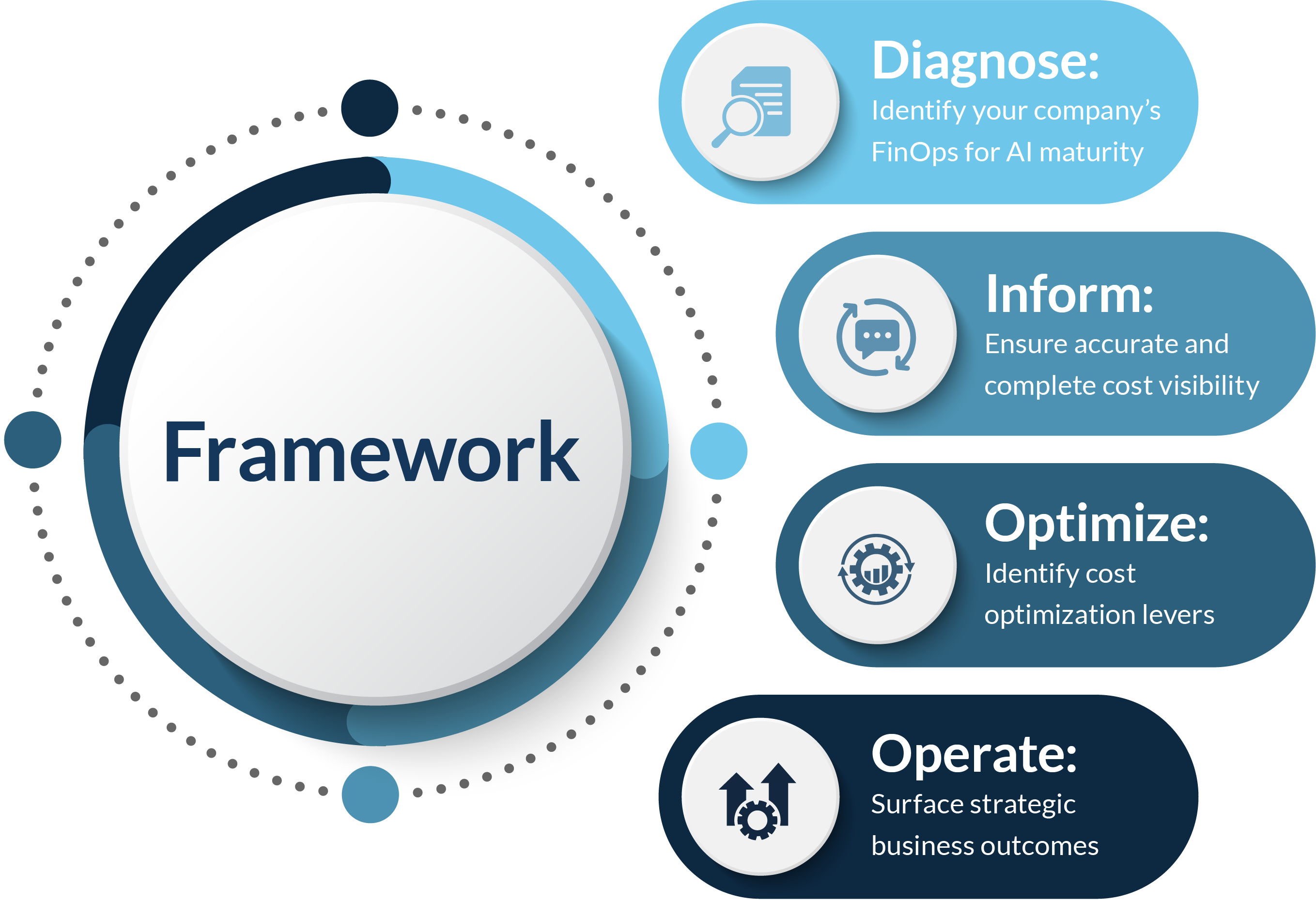
Our new Leadership Guide to FinOps for AI lays out a four-step framework to bring AI costs under control and connect them to business value:
Diagnose. Start with a maturity assessment. Do stakeholders across finance, engineering, and FinOps agree on the current state of AI costs? Understanding where your company sits, from fragmented awareness to rigorous governance, creates the call to action for everything that follows.
Inform. Build accurate, complete cost visibility. That means identifying which AI architectures your business actually uses, tagging and allocating AI costs properly in your FinOps system, and deciding how you’ll calculate unit economics for your business.
Optimize. AI comes with its own cost levers, and they’re not the same ones you know from traditional cloud management. Some belong to data science teams, but a surprising number sit squarely with FinOps practitioners, and applying them well can yield significant savings. The guide breaks down which levers to pull and who owns each one.
Operate. This is where cost data becomes strategy. The guide details the analysis FinOps teams should proactively surface, spanning investment decisions, governance adherence, AI activation, and model portfolio choices.
The leaders are already moving
66% of senior leaders report AI has already driven significant productivity improvements across their organization. The value is real. What many organizations still lack is the cost side of the equation: knowing what AI costs, who’s driving the spend, and which investments deserve to grow.
Download The Leadership Guide to FinOps for AI for the full framework to build that discipline.


