IBM’s CIO organization uses Apptio solutions to unlock the value of AI investments.
Executive summary
When it comes to AI projects, most enterprises face the same basic problem: they have no clear way to measure the costs (or value) of those initiatives. IBM’s CIO organization understood the problem very well and solved it.
Using IBM Apptio Costing alongside ServiceNow, IBM Cloudability, and IBM Targetprocess, IBM built a four-phase process for AI governance and TCO that reduced AI deployment friction, cut software request processing time, and connected AI spend directly to business outcomes through automated digital KPIs—all without a single manual input.
Starting with a firm foundation
At the start of IBM’s Apptio journey, the IBM’s CIO organization was supporting a client base of 300,000 users with a $2.5 billion budget and 10,000 IT professionals. Two short years later, IBM’s technology portfolio had begun to rapidly evolve with the introduction of AI. New use cases, platforms, and agents were being deployed continuously across every part of the business. IBM’s challenge was not whether to invest in AI, but how to govern, track, and measure that investment with the same rigor applied to any other major area of IT spend.
Fortunately, IBM had already laid the groundwork for a solution. As part of a multi-year IT Transformation initiative, the company implemented the Apptio Integrated Suite (IBM Apptio Costing, IBM Cloudability, and IBM Targetprocess). This enabled IBM’s CIO organization to completely overhaul the way the company managed IT financials, providing cost transparency, and delivering real TCO for thousands of applications.
With this foundation in place, IBM then turned its attention to measuring the return of AI investments.
Creating a path to production for agentic AI
As AI projects multiplied across IBM’s business units, two compounding problems emerged: duplicative investments and invisible costs.
On the governance side, teams were at risk of building solutions with no shared view of what already existed. “In one example, I had five different teams ask to build a chatbot for their product,” says Summer Gu, CIO TBM leader, at IBM. “But we didn’t need five chatbots; we only needed one that worked for all.”
On the cost and value side, the AI deployment process was slow and tedious. Once a model was built and ready to deploy, it took two to four weeks to get into production as teams worked through a fragmented, manual process that included provisioning, security compliance, account setup, and cost registration.
Measuring the return on AI investment was unreliable. Business value reporting depended on estimates entered manually into PowerPoint slides and online forms, not source data. Spending could not be traced back to measurable outcomes, making it a challenge for leaders to trust the numbers.
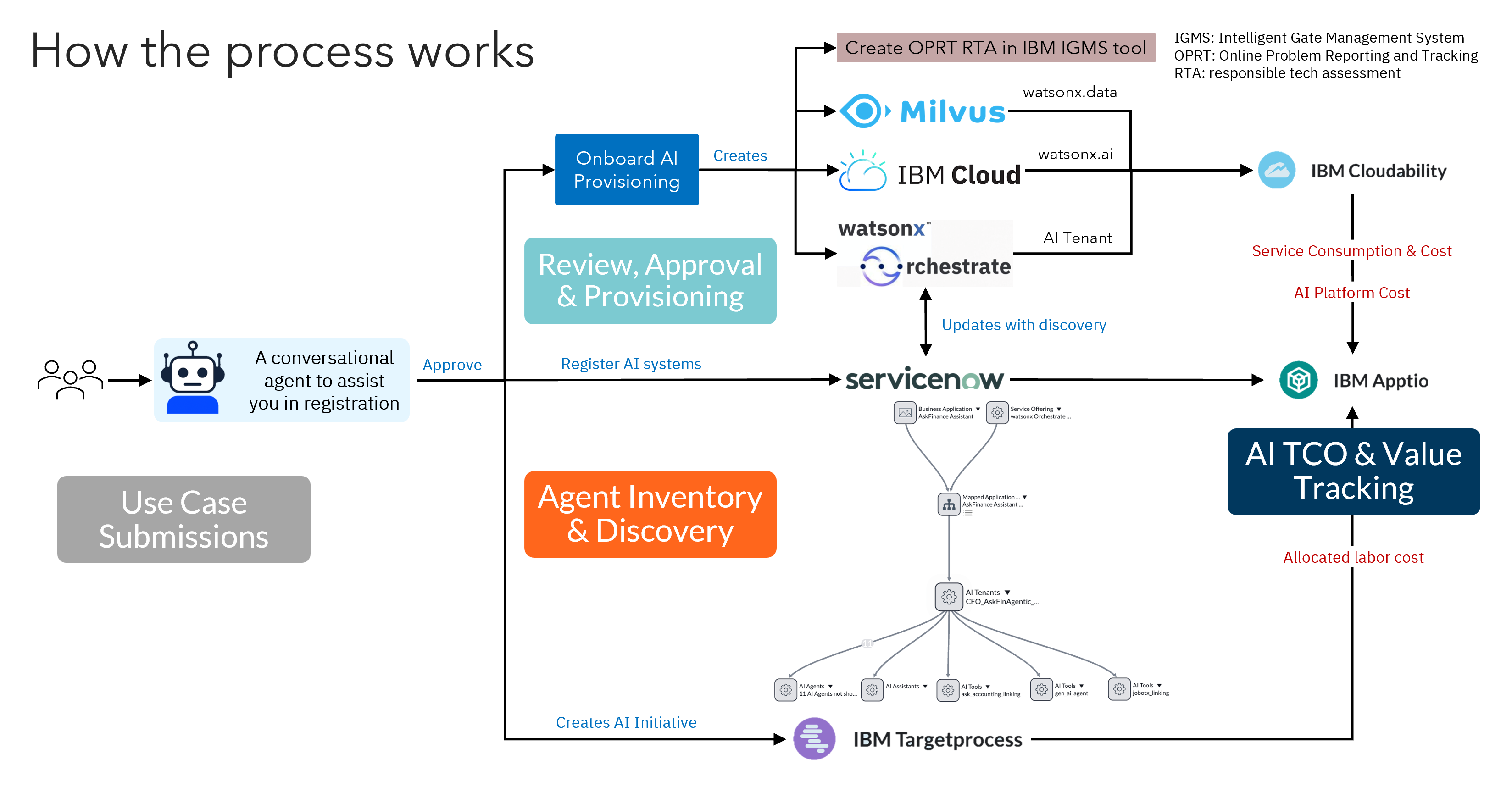
To save time, reduce complexity, and increase cost transparency, IBM designed a four-phase process for AI governance and TCO built on three guiding principles: discover automatically, collect data once, and share data systematically. The phases move from use case submission through review and provisioning and culminate in continuous AI TCO and value tracking.

Phase 1: Use case submission
Every AI initiative begins with a structured submission, defining what the use case does, what outcome is expected, and what services it requires. A conversational agent guides users through onboarding, replacing ad hoc requests with a consistent, discoverable intake process.
Phase 2: Review and approval
Before any AI project proceeds, IBM validates whether equivalent capability already exists. The agent inventory and discovery registry—maintained in ServiceNow’s CMDB—gives reviewers a live view of all AI systems in production, including which applications they support, what service offerings they touch, and which AI tenants and tools they consume. This is the layer that prevents five teams from building the same chatbot.
Phase 3: Automated provisioning
Approved use cases trigger automated provisioning: IBM Cloud accounts or equivalent platform accounts are created, required AI services are enabled, security and compliance records are generated in IBM’s governance tooling, and the AI system is registered in ServiceNow. Simultaneously, an AI initiative is automatically created in IBM Targetprocess—IBM’s agile planning tool—so that work can be broken down into capabilities, features, and stories and tracked as a project from day one, along with the labor cost required to deliver the AI use case.
Phase 4: AI TCO and value tracking
The final phase is where financial accountability is established. IBM’s AI TCO model separates infrastructure cost and labor cost, and within each, distinguishes between AI platform costs and AI use case costs—all sourced directly from IBM Cloud billing data. An AI tagging strategy applied consistently across ServiceNow, Cloudability, and Targetprocess enables cost reporting by platform, use case, service type, and month, with the ability to drill down from summary to line-item level.
AI investment is then mapped to IBM’s Enterprise Intelligent Workflow framework and fed into the Enterprise Business Management model, connecting spend to business value through standardized digital KPIs such as unit cost, flow velocity, volume, and AI effectiveness. These metrics are calculated automatically from source data, and no human input is required.
Productivity improvements and process optimization
AI governance that prevents wasted investment – 70% reduction in software request processing time
For the CIO Vendor Management Team at IBM, average processing time per software request dropped by 70%. This result was calculated automatically from source system data through IBM’s digital KPI framework, providing auditable proof of AI’s operational impact. It also demonstrates the compound effect of AI adoption when it is tracked and managed rigorously: the efficiency gain is real, measurable, and tied directly to the investment that produced it.
Automated cost-to-value connection – 5% increase in work volume with no additional resources
The same team increased work volume by 5% without adding headcount or cost. More work, same team, lower unit cost—an ROI story based on actual data sourced directly from production systems rather than self-reported spreadsheets.
AI governance that prevents wasted investment
By maintaining a live AI agent inventory in ServiceNow and requiring all new AI initiatives to pass through a structured review, IBM eliminated the duplicated build problem. Teams no longer launch AI projects without visibility into what already exists. The cost of redundant chatbots, agents, and models that would otherwise have been built and abandoned is difficult to quantify precisely, but the governance framework that prevents it is now operational and scalable.
Automated cost-to-value connection
IBM’s CIO organization can trace AI spend back to business outcomes automatically. Digital KPIs update from source data without human intervention, mapping cost to unit efficiency, throughput, and AI effectiveness at the team level. For senior IT leaders, this is the capability that changes the AI investment conversation with finance: it’s no longer a projected ROI built on assumptions, but a live dashboard that shows what AI costs and what it is delivering, month by month.
Learn more
The frameworks described here—four-phase governance, consistent tagging, automated provisioning, and digital KPI tracking—are replicable. They do not require IBM’s scale to be effective. To explore how the IBM solutions featured in this story can support your AI journey, contact your IBM account representative or IBM Business Partner.

![ApptioCareers-Employee[1]](data:image/svg+xml;base64,PHN2ZyB4bWxucz0iaHR0cDovL3d3dy53My5vcmcvMjAwMC9zdmciIHZpZXdCb3g9IjAgMCAyMjUgMjc1IiB3aWR0aD0iMjI1IiBoZWlnaHQ9IjI3NSIgZGF0YS11PSJodHRwcyUzQSUyRiUyRnd3dy5hcHB0aW8uY29tJTJGd3AtY29udGVudCUyRnVwbG9hZHMlMkZlbGVtZW50b3IlMkZ0aHVtYnMlMkZBcHB0aW9DYXJlZXJzLUVtcGxveWVlMS1xZzVuenB5MHdoaWJtbzZvdmJqNGM3MHh0aTUzdmo1OHM0endwajh0dHMucG5nIiBkYXRhLXc9IjIyNSIgZGF0YS1oPSIyNzUiIGRhdGEtYmlwPSIiPjwvc3ZnPg== "ApptioCareers-Employee[1]")