
![ApptioCareers-Employee[1]](data:image/svg+xml;base64,PHN2ZyB4bWxucz0iaHR0cDovL3d3dy53My5vcmcvMjAwMC9zdmciIHZpZXdCb3g9IjAgMCAyMjUgMjc1IiB3aWR0aD0iMjI1IiBoZWlnaHQ9IjI3NSIgZGF0YS11PSJodHRwcyUzQSUyRiUyRnd3dy5hcHB0aW8uY29tJTJGd3AtY29udGVudCUyRnVwbG9hZHMlMkZlbGVtZW50b3IlMkZ0aHVtYnMlMkZBcHB0aW9DYXJlZXJzLUVtcGxveWVlMS1xZzVuenB5MHdoaWJtbzZvdmJqNGM3MHh0aTUzdmo1OHM0endwajh0dHMucG5nIiBkYXRhLXc9IjIyNSIgZGF0YS1oPSIyNzUiIGRhdGEtYmlwPSIiPjwvc3ZnPg== "ApptioCareers-Employee[1]")
Organizations and enterprise systems have more data than ever before, broadly categorized as financial, operational, cloud, vendor, contracts, assets, labor or workforce data. Yet having more data does not automatically lead to improved information or better insights. Before it can be used for analysis, teams must first bring that information together and turn it into a consistent, usable format.
Enterprise data rarely arrives ready to use, and information is collected from different systems that follow inconsistent formats, naming conventions, and levels of detail. Teams must manually classify and map records, normalize variations, enrich incomplete information, and extract usable data from unstructured data sources. This process is extremely manual and time-consuming. According to an EY survey, these activities can consume up to 45% of teams’ time, delaying insights, and limiting their capacity for more valuable analysis.
As organizations enter the AI era, the volume, variety, and complexity of data have grown exponentially, making it more difficult to prepare and maintain trusted data foundations. The complexity continues with new data created and ingested, as teams must continuously update mappings and reconcile challenges to maintain consistent results. Relying on disconnected or external data-preparation tools can introduce additional security and governance risk, while inconsistent preparation methods can produce outputs that are difficult to trust.
When data takes too long to prepare or remains inconsistent, decision-making slows and confidence in the results decline. Without timely, trusted insights, leaders struggle to respond to changing business needs, allocate resources effectively, and act on opportunities.
Prepare Data Faster and More Reliably with IBM Apptio AI Data Assistant
Embedded directly within IBM Apptio, the AI Data Assistant helps teams transform complex data from multiple sources into consistent, analysis-ready information with less manual effort. It creates a faster, more scalable foundation for reporting and insights while keeping data preparation within existing IBM Apptio workflows.
With AI Data Assistant, organizations can:
- Accelerate data preparation with intuitive, embedded AI workflows
- Maintain accuracy and control by reviewing, editing, and overriding AI-generated outputs
- Scale repeatable processes as new data is introduced without affecting existing results
- Protect sensitive information through secure, in-platform AI processing
- Accelerate time to insight and time value
Together these platform capabilities support four core data-transformation activities:
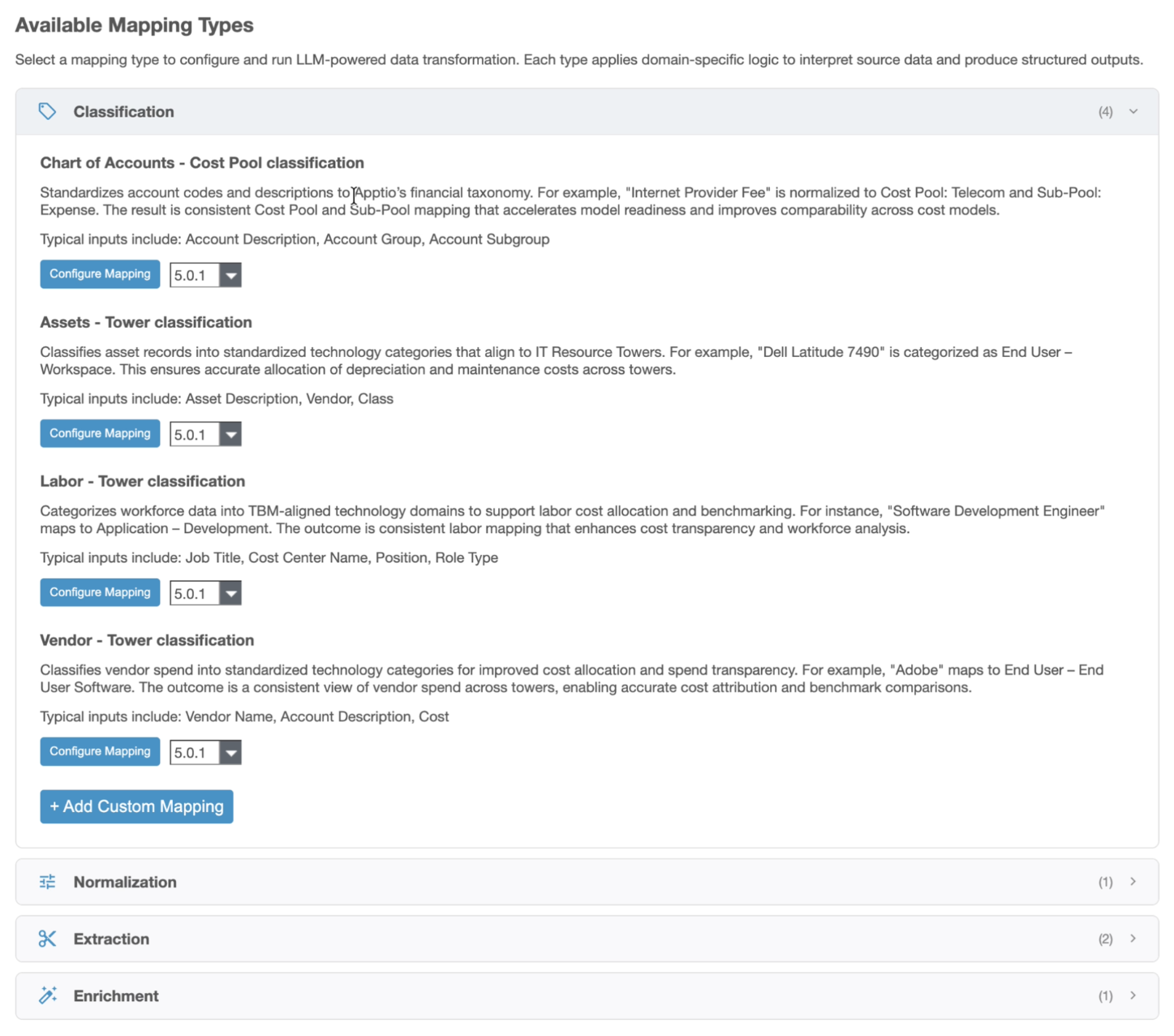
Classification
Classifying financial and operational data into TBM taxonomies has traditionally meant reviewing Chart of Accounts, Assets, Labor, and Vendor records line by line.
Accelerate the onboarding of new data by automatically classifying financial, vendors, labor, and asset data into standardized TBM taxonomies and customer-specific models. By reducing manual mapping effort and improving consistency, teams can onboard data faster and deliver trusted insights sooner.
Common use cases include:
- Accelerating TBM implementations and onboarding activities
- Classifying financial, operational, and organizational data at scale
- Improving consistency across cost transparency and financial reporting
- Supporting taxonomy migrations, such as TBM v4 to TBM v5
Normalization
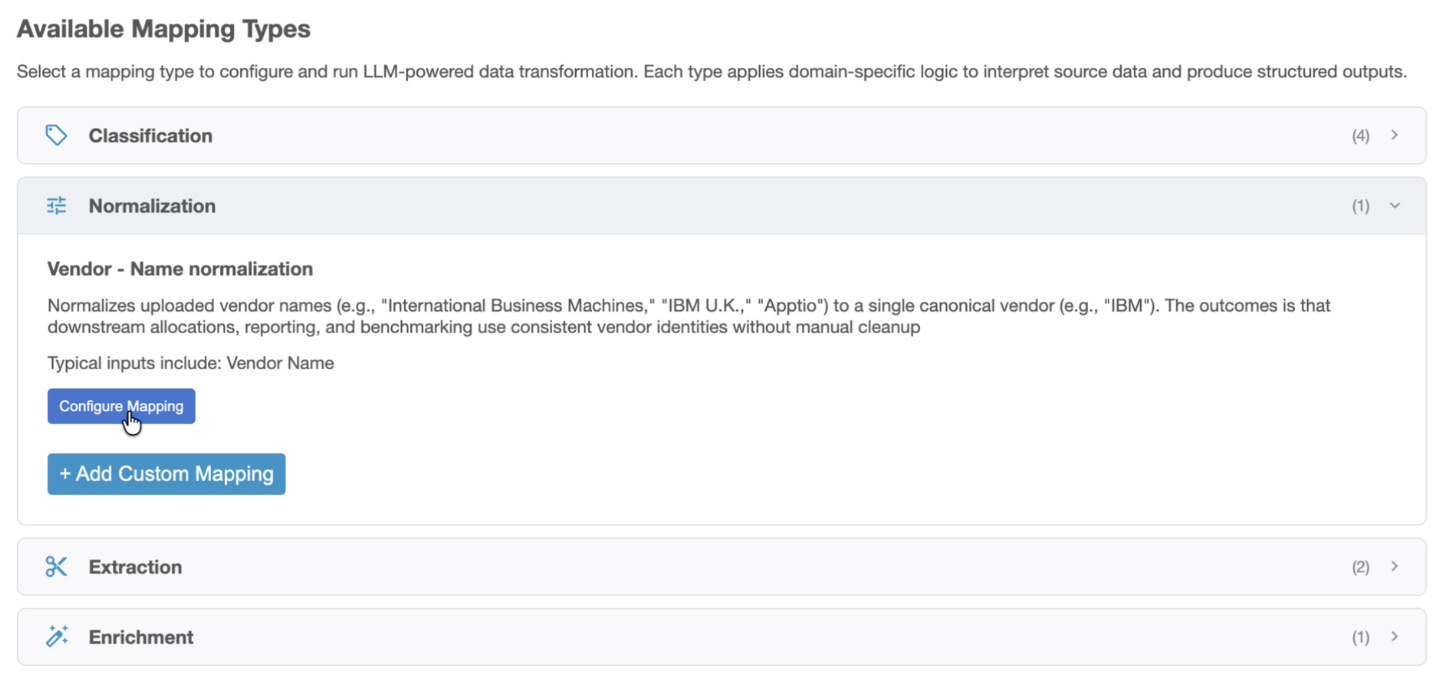
Organizations often bring in data from multiple systems, each with its own definitions, values, and naming conventions, so the same vendor can show up under a dozen different names.
Improve data quality by standardizing inconsistent values across systems into a trusted, analysis-ready format. AI Data Assistant helps create a single source of truth that improves reporting accuracy and reduces ongoing maintenance effort.
Common use cases include:
- Consolidating duplicate vendor, product, and workforce records
- Standardizing naming conventions across multiple source systems
- Improving confidence in financial reporting and analysis
- Reducing the effort required to maintain data quality over time
Enrichment
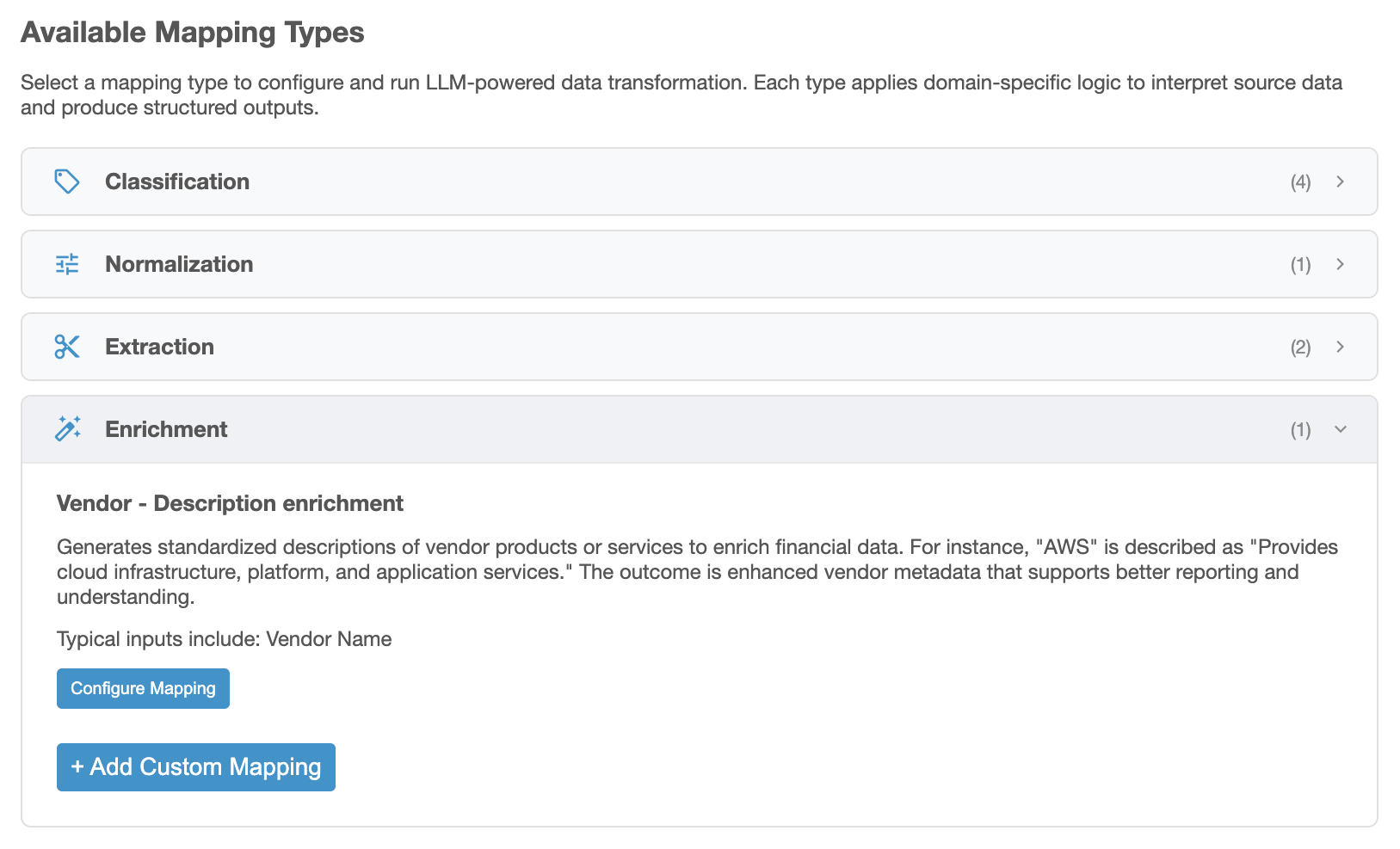
Raw records rarely carry the context finance teams need. A line item might just read “AWS” or “Adobe,” with no indication of what the vendor actually provides.
Increase the value of your data by adding meaningful business context and structured attribution automatically. By enriching data with additional details and descriptions, organizations can improve visibility into costs, services, and business activities without manual research.
Common use cases include:
- Adding business context to vendor, financial, and operational data
- Improving the completeness and usability of datasets
- Enhancing reporting with richer cost and service insights
- Reducing manual effort spent researching and attributing records
Extraction
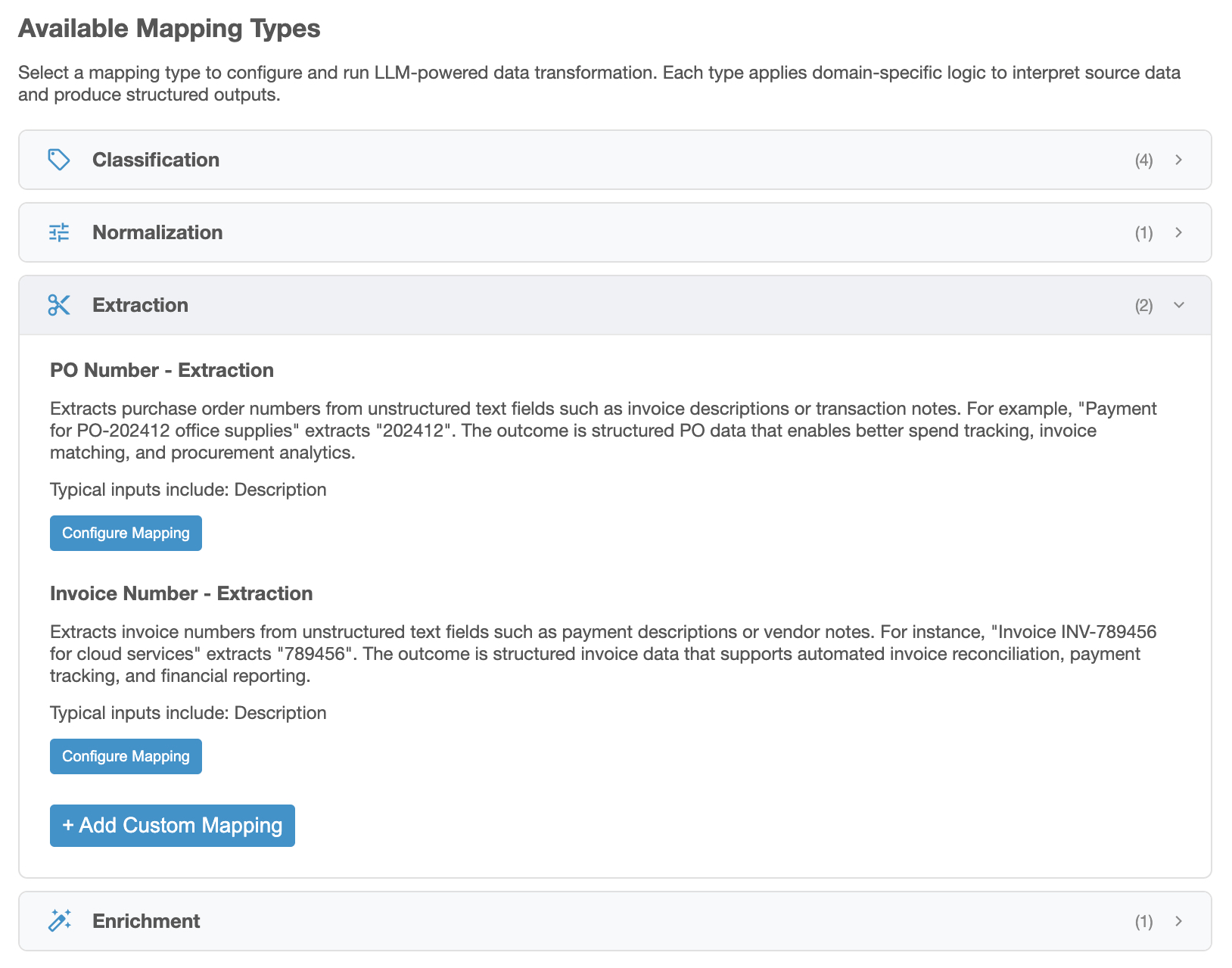
Details like PO numbers, invoice numbers, and vendor references are often buried in unstructured sources such as free-text fields, invoices, or descriptions rather than in a clean, structured column.
With AI Data Assistant, you can now unlock value from unstructured information by converting documents, invoices, and free-text fields into structured data formats. This helps organizations make information available for analysis while reducing manual processing effort.
Common use cases include:
- Extracting key information from invoices and financial documents
- Converting unstructured content into analysis-ready data
- Improving data completeness and reducing manual data entry
- Accelerating reporting and downstream analytics processes
How AI Data Assistant Works
Getting started follows a simple, four-step flow inside your existing TBM Studio pipeline:
- Source Data – Select the source data and business context you want AI Data Assistant to use.
- Map Data – Define how that data should be transformed: classification, normalization, enrichment, or extraction.
- Generate Data – AI Data Assistant analyzes the data and automatically generates mappings, descriptions, and standardized values.
- Review & Operationalize – Review and refine the results, then apply them to support ongoing data transformation as new data comes in.
Start Turning Data into Insights Faster
The value of data is determined not by how much you collect, but by how quickly and confidently you can use it. AI Data Assistant helps organizations accelerate time to value by removing manual bottlenecks during data preparation and by bringing AI-powered data classification, normalization, enrichment, and extraction embedded directly within IBM Apptio.
With secure, in-platform workflows and human-in-the-loop validation, teams can accelerate onboarding, improve data quality, build a strong data foundation, and scale ongoing data management with operational efficiency.
Start using AI Data Assistant today and see how AI can help transform complex data into trusted insights.


